Aphrodite


Aphrodite
Goddess of..
Beauty, Love, Motherhood, Pleasure, Sea, SexName Variants
Aphrodite (primary Greek name). Common epithets: Cypris, Cytherea, Paphia, Ourania (Heavenly), Pandemos (Of the People), Philommeides (Laughter-loving), Euploia (Fair Voyage). Roman equivalent: Venus. Ancient cultural links to Semitic Astarte/Ishtar via Cyprus.
Cognate Goddesses
Venus (Roman — direct cultural heir); Astarte (Phoenician/Canaanite via Cyprus); Ishtar/Inanna (Mesopotamian — love, fertility, war, descent); some Hellenistic syncretism with Hathor and Isis.

Venus de Milo (Hellenistic sculpture often identified with Aphrodite), Louvre Museum — public domain / museum photography.
Consorts and Offspring
Consort: Hephaestus (husband). Primary lover: Ares. Offspring: Eros (many traditions), Harmonia, Phobos, Deimos, Aeneas
Favourites and Familiars
Animals: Dove (primary), swan, goose, sparrow. Plants: Myrtle, rose, apple. Often accompanied by Eros and the Charites. Magical attribute: golden girdle (kestos) that inspires irresistible desire.
Summary
Aphrodite rises from sea foam near Cyprus — the laughter-loving goddess who bewitches gods and mortals with her golden girdle. She sparks the Trojan War, mourns Adonis, and brings Pygmalion’s statue to life. Worshipped with roses and doves in Cypriot and Corinthian temples, she rules hearts, fertility, and sailors’ voyages. Her Roman twin Venus carried her flame into empire and Renaissance art; today she remains the eternal muse of romance and the divine feminine.
Longer Introduction
Aphrodite embodies the irresistible force of attraction, sensual beauty, and generative love that moves both cosmos and human. Hesiod’s Theogony gives her the most dramatic origin: from the white foam (aphros) that gathered around the severed genitals of Ouranos, flung into the sea by Kronos. The waves bore her first to Cythera, then Cyprus, where flowers sprang from her footsteps and she was attended by Eros and Himeros (Desire). This sea-born birth forever ties her to ocean rhythms, creation from chaos, and the mysteries of fertility emerging from the deep. Homer presents a more Olympian lineage — daughter of Zeus and Dione — integrating her fully into the divine family. Married to the lame smith Hephaestus, her passions roamed. Her famous affair with Ares produced Harmonia and, in some traditions, Eros. Hephaestus’s golden net exposed the lovers to divine laughter. She played a fateful role in the Trojan War: bribing Paris with Helen’s love in the Judgement of Paris, then protecting her son Aeneas (by the mortal Anchises). Beyond story, her worship was vibrant and widespread. Primary sanctuaries stood in Cyprus (especially grand festivals at Paphos) and Cythera. In Corinth her temple employed hierodouloi (sacred prostitutes), though scholars debate the precise historical practice. Epithets reveal her range: Ourania for elevated spiritual love, Pandemos for everyday physical desire, Euploia as harbor protector. In Sparta she appeared armed as Aphrodite Areia — love fused with martial courage. Artistically inspired revolution: Praxiteles’ Aphrodite of Knidos was the first life-size female nude in Greek sculpture. Today she lives on in neopagan circles, feminist reclamations, and endless artistic reinventions.
Bibliography and Links
Primary sources: Hesiod, Theogony; Homer, Iliad & Odyssey; Homeric Hymn 5 to Aphrodite; Pausanias, Description of Greece; Ovid, Metamorphoses; Apollodorus, Library. Modern references: Theoi Project — Aphrodite (https://www.theoi.com/Olympios/Aphrodite.html); Wikipedia “Aphrodite” (with extensive classical citations); Walter Burkert, Greek Religion (Harvard University Press). Image sources: Wikimedia Commons (public domain classical sculptures and museum CC0 releases).
General Region
Mediterranean, Asia Western
Region & Culture
Ancient Greece (especially Cyprus — mythic birthplace and major cult center at Paphos; Cythera; Corinth; Athens; Sparta), Roman Empire (as Venus), with deep roots in Phoenician/Canaanite Levant via Cyprus. Later Hellenistic syncretism including Egypt.
Pantheon
Greek Olympian (one of the Twelve); also Roman as Venus.
Symbols, Attributes & Iconography
Golden girdle (kestos); scallop shell; mirror; roses, myrtle; doves, swans; golden apples. In art: often nude or semi-draped, rising from the sea, riding swan/goose, or with Eros and the Graces. Some cult statues show her armed (Sparta) or enthroned in majesty.
Era of Worship
Archaic period (8th–6th c. BC) onward; flourished in Classical and Hellenistic eras; continued as Venus in Roman period; revived in Renaissance and active today in neopagan and feminist traditions.
Cult Sites
Aphrodite’s worship radiated from Cyprus, her mythic birthplace. The grand sanctuary at Palaipaphos (Kouklia) — with its ancient baetyl and later Roman temple — was the island’s spiritual heart and a major pilgrimage site. Other key Cypriot centres: Amathous and Kition. On Kythera stood one of her earliest Greek sanctuaries. In mainland Greece, Corinth’s temple on Acrocorinth linked her to prosperity; Athens honoured multiple aspects (Ourania, Pandemos, Euploia). Sparta venerated an armed Aphrodite Areia. Further west, the dramatic mountaintop sanctuary at Eryx (Sicily) became a major centre, later adopted by Rome as Venus Erycina. These coastal, mountain, and urban sites reflect her many faces across the Mediterranean.
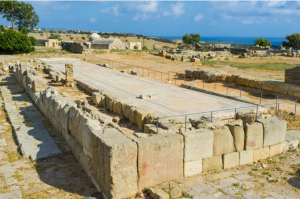
Ruins of the Sanctuary of Aphrodite Paphia at Palaipaphos (Kouklia), Cyprus — the goddess’s primary cult centre. (Public archaeological site, open-source photography)
AI Prompt Template
Cinematic portrait of Aphrodite, goddess of love and beauty, emerging from sea foam on a golden shell, long flowing wavy golden hair with pearls, radiant flawless skin, gentle seductive smile, wearing a sheer translucent white Greek chiton that flows in the wind, surrounded by white doves and blooming red roses, soft golden hour sunlight, ethereal glow, hyper-detailed face and fabric, romantic atmosphere, masterpiece, 8k, intricate details --ar 3:4 --stylize 200