Amphitrite

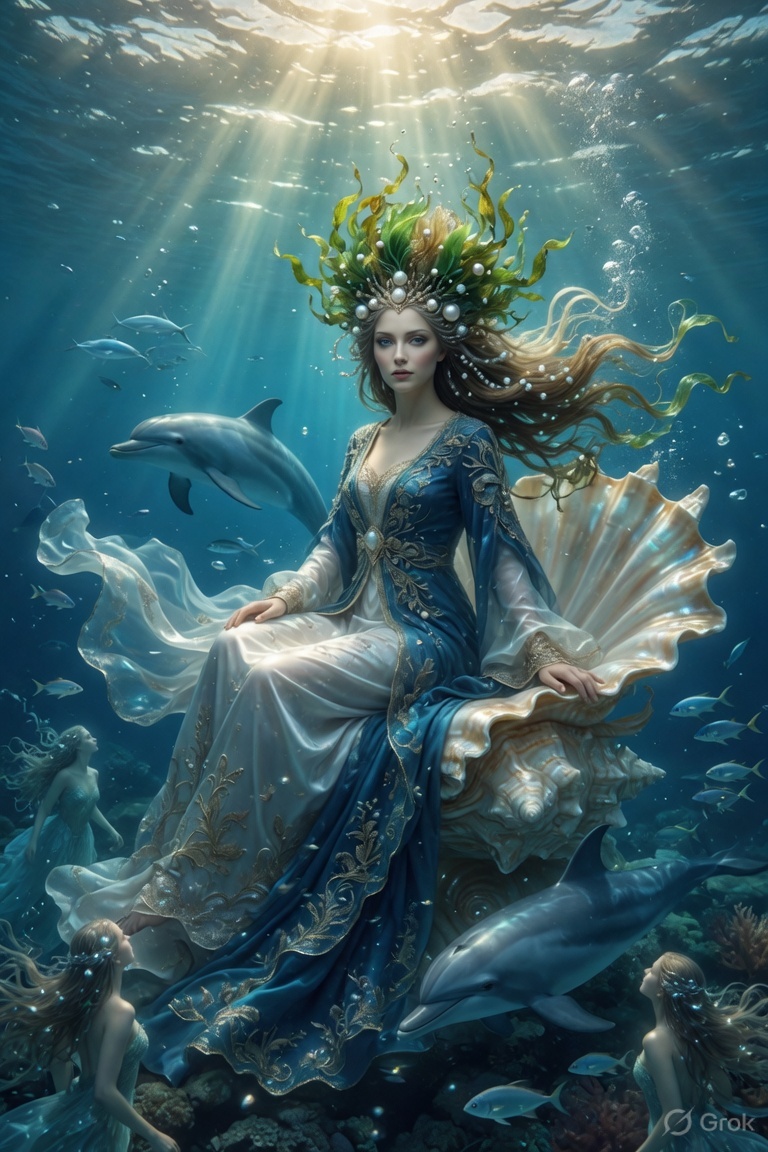
Amphitrite
Goddess of..
SeaName Variants
Salacia (Roman)
Cognate Goddesses
Salacia (Roman equivalent); Thalassa, the primordial personification of the sea in ancient Greece
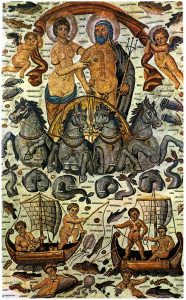
Roman eras mosaic featuring Poseidon (Neptune) and Amphitrite
Consorts and Offspring
Consort of Poseidon and mother of Triton, a merman and the messenger of the seas. Thetis, one of Amphitrite's most famous sisters, shares her high status as one of the most prominent and respected sea nymphs. Galene, another sister, was revered as the personification of calm, smooth seas
Favourites and Familiars
Dolphins
Summary
Amphitrite is the Greek goddess of the sea and queen consort of Poseidon. Originally one of the Nereids (or sometimes listed among the Oceanids), she became the divine wife of the sea god after he chose her (in some versions after a pursuit or with the help of a dolphin messenger). The Nereids were fifty beautiful sea nymphs born to Nereus and Doris. As a collective group of deities, they share Amphitrite's domain and work to protect sailors and calm the seas.
Longer Introduction
Amphitrite is the queen consort of Poseidon and mother of Triton (the merman messenger with a conch-shell horn) and other sea deities. Though less mythologically active than some Olympians, she appears in numerous sea processions, often riding beside Poseidon in a chariot drawn by hippocampi (sea-horses) or dolphins. She represents the calmer, regal aspect of the sea — its beauty, abundance, and sovereign power — complementing Poseidon's more tempestuous nature.
Bibliography and Links
Wikipedia article about Amphitrite: https://en.wikipedia.org/wiki/Amphitrite
General Region
Mediterranean
Region & Culture
Worshipped in coastal Greek communities, often jointly with Poseidon. Major sites included the Isthmus of Corinth (Isthmian Games honored Poseidon but Amphitrite had presence), Cape Taenarum, and many seaside shrines. She appears frequently in classical art, especially vase paintings and Roman mosaics showing the divine couple's marine thiasos (procession).
Pantheon
Ancient Greek Civilisation
Symbols, Attributes & Iconography
Dolphin & Fish: Constant companions and symbols of the sea Sea Chariot or Throne: Often shown with Poseidon in a shell or hippocamp-drawn chariot Crown of Seaweed, Pearls, or Coral: Regal marine headdress Flowing robes that ripple like waves or water Triton or Nereids as attendants Conch shell or other marine attributes
Era of Worship
Ancient Greece and Rome
Cult Sites
Worshipped in coastal Greek communities, often jointly with Poseidon. Major sites included the Isthmus of Corinth (Isthmian Games honored Poseidon but Amphitrite had presence), Cape Taenarum, and many seaside shrines. She appears frequently in classical art, especially vase paintings and Roman mosaics showing the divine couple's marine thiasos (procession).

Temple of Poseidon (later converted into a Byzantine Church) Image Credit : Jean Housen
AI Prompt Template
Regal portrait of Amphitrite, Greek queen of the sea and wife of Poseidon, beautiful powerful woman with long flowing hair adorned with seaweed crown and pearls, elegant sea-blue and white robes flowing like waves, seated on a shell throne or in a dolphin-drawn chariot, surrounded by dolphins, fish, and Nereids, soft underwater golden light filtering from the surface, serene yet sovereign expression, hyper-detailed, 8k --ar 3:4 --stylize 210